Reflektive Reflektive logo

Evolution of Reflektive: We’re Now Part of PeopleFluent and LTG

In 2014, Rajeev Behera, Erick Tai, and Jimmie Tyrrell founded Reflektive to bridge the feedback gap between managers and employees. Reflektive has since become a recognized leader in performance management by G2, Brandon Hall Group, TalentCulture, and Gartner. Forward-thinking companies such as Allbirds, FabFitFun, Grubhub, and Protective now depend on Reflektive to align goals and scale constructive, ongoing conversations that increase their employee engagement and productivity by 2X.

Today, Reflektive enters the next phase of its innovation and growth. Learning Technologies Group plc (LTG), the parent company of PeopleFluent, has signed an agreement to acquire Reflektive. Reflektive’s complementary performance management capabilities will be part of PeopleFluent’s talent management portfolio, enhancing its engagement and analytics capabilities. 

Addressing the Modern Talent Journey

The shift to remote work due to COVID-19 has meant adapting to business today by reimagining the customer experience for tomorrow. As part of PeopleFluent, our customers will be able to utilize a single solution for recruitment, talent mobility, performance, compensation, succession, and learning, as well as organizational charting. The Reflektive and PeopleFluent solutions will work together or separately to connect the modern talent journey – to recruit top talent, identify skills gaps, provide opportunities to learn, and define paths for career growth. 

People analytics presents one of the most exciting innovation opportunities for the combined companies. This last year, people leaders looked to use data to inform employee engagement; employee experience; diversity, equity and inclusion; and remote work. Integrating Reflektive and PeopleFluent technologies will bring together a comprehensive view of the employee experience to measure progress and engagement. Richer data of over 25 million users will also accelerate artificial intelligence-based predictions and automated processes. In the future, PeopleFluent customers will be alerted about risks and opportunities in their organization, such as a potential drop in engagement within a department or an employee at risk of leaving. 

Part of LTG

As part of LTG, PeopleFluent offers world-class service and an unparalleled ecosystem of partners to more than 1,500 customers across more than 200 countries worldwide, including NBCUniversal, Schwan Foods, Johnson Controls, Comcast, and Shell. PeopleFluent’s resources and global scale will support the growth of Reflektive customers.

We are excited about this opportunity and what it means for Reflektive, PeopleFluent, and our joint customers. Our combined technologies are poised to transform talent management so our customers can transform their businesses.

Learn more about our acquisition by reading the LTG and PeopleFluent press releases, and for our customers, stay tuned for updates from your customer success team.

Calibration at Reflektive: New Offering & Best Practices for HR Teams

Calibration. A big word for a complex process. 

Whether you’re aligning on performance reviews or selecting future company leaders, calibration is often an emotionally-charged term. Calibration has historically been a manual, frustrating process for all involved. And it often doesn’t accomplish its objectives — eliminating biases, addressing ratings inconsistencies across teams and managers, and adding clarity to talent management decisions.

For years, companies have either endured the time-consuming and sometimes ineffective process – or scrapped it all together.

It’s no wonder that calibration brings frustration and fear to mind — when was the last time a calibration session left you feeling empowered?

A New Start: Calibration in 2021

But what if we turned traditional calibration into a modern, data-driven process—one that not only saves time, but also incorporates multiple data sources to create a more complete, unbiased view of performance and talent? 

We’re excited to announce Reflektive Calibration is coming soon! 

This solution helps HR teams by:

What makes our solution unique is that it incorporates employee feedback and recognition, so managers have a broader understanding of performance over time instead of anchoring on the most recent performance anecdotes. Reflektive Calibration supports annual, quarterly, monthly, and even on-demand calibration sessions. 

We’ve heard from several customers that they appreciate having one go-to place for all performance data. Specifically, they like being able to:

Our early adopters have also benefited from the solution’s ease of use and time savings. Per Taylor Orr, Learning & Org Development Program Manager at Dropbox, “The ROI of Reflektive Calibration is definitely there for me. With our previous manual process, I had to export all our data, blend it with demographic data, upload it into our calibration system, and export the results to be uploaded back into Reflektive. It was a massive effort, and a huge time drain. With Reflektive, I didn’t have to do manual work — instead I was able to spend more time enabling HRBPs to have successful calibration sessions.”

But technology alone can’t drive an improved calibration process — it takes effective leadership and communication to ensure that performance and talent planning are equitable. Below are some common questions we receive from customers, and the best ways to drive calibration forward.

Calibration FAQs

What does an ideal calibration process look like?


Pre-Calibration
– Start with useful data from your performance reviews. To ensure that your reviews are providing valuable information, check out our Guide to Launching Reviews & Check-Ins.
– Determine calibration objectives (e.g., talent planning, deciding on promotions, assigning fair performance reviews)
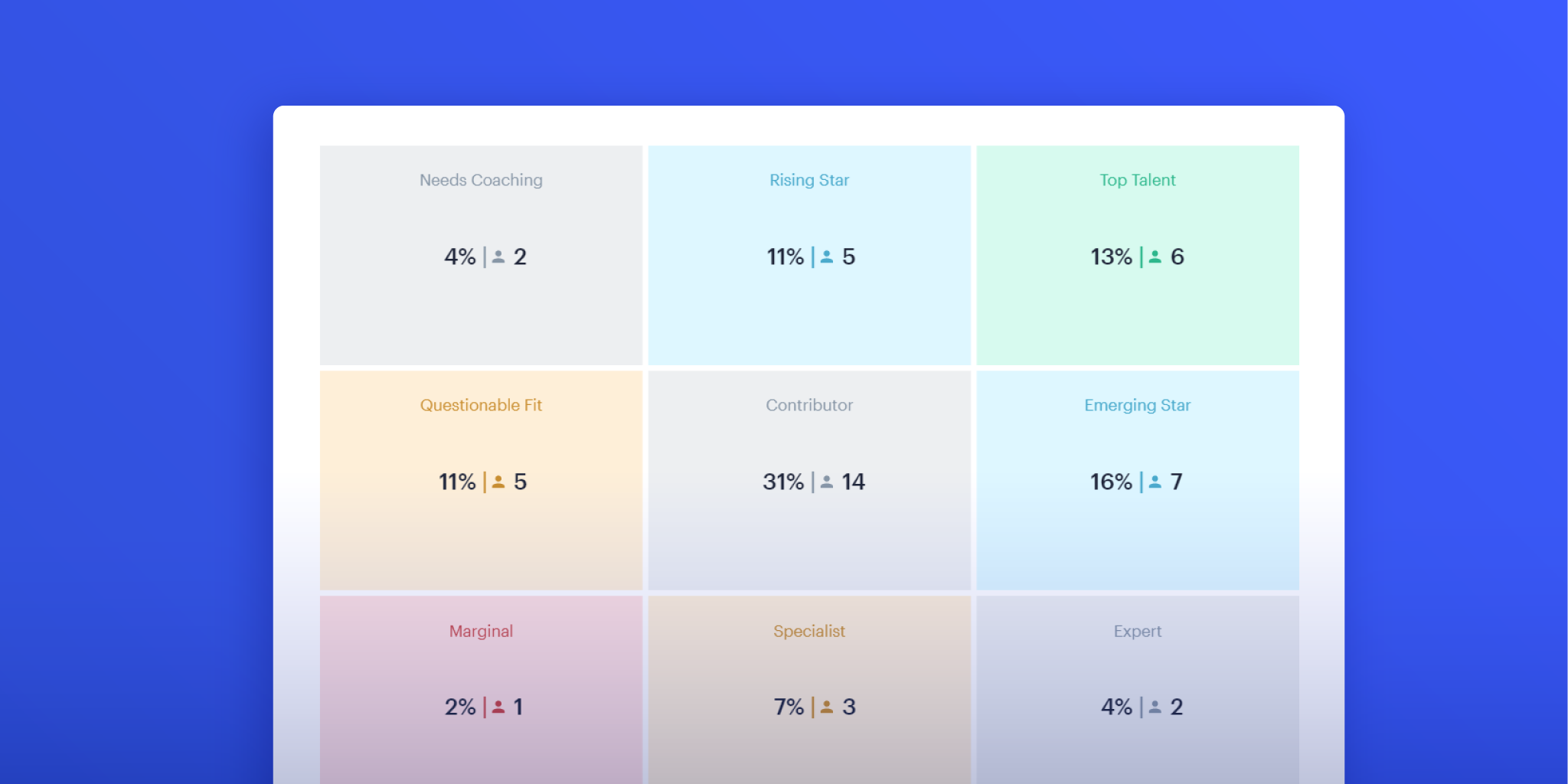
– Prepare calibration data, such as review ratings, 9-box ratings, feedback, and recognition (Reflektive customers can easily add and manage calibration data in a customizable table!)
– Share data with calibration session participants. Ask participants to look for employee performance trends, and flag inconsistencies, prior to the calibration session.
– Determine number of calibration sessions needed based on number of managers and seniority
– Schedule calibration sessions for each division and level as needed. In email invite, remind attendees of:
– Objective(s) of calibration session
– Framework for how ratings should be determined

Calibration Session
– Recap objective and set ground rules
– Recap ratings framework
– Share-out ratings trends observed, as well as key areas that need to be addressed
– Discuss employee performance, including whether ratings should be modified
– Review each participant’s ratings distribution to see if it is “normal”. If ratings do not fall into a bell curve, discuss why not.
– Adjust ratings as needed

Post-Calibration
– Send a follow-up email communication with session participants
– Update records with calibrated values (this can be done in one click with Reflektive!)
– Use calibrated ratings as input for bonuses or other pay for performance systems, if applicable

It’s difficult for me to facilitate calibration sessions with so many different personalities in the meeting. Anything I can do to ensure that everyone has a voice?

– Ensure everyone is at the same level in the meeting, so participants will feel more comfortable speaking up
– Break up into smaller groups if meeting is too big, to give everyone a chance to speak
– Set ground rules, e.g., everyone will have a turn to speak and no one will be interrupted
– Set start time and end time to drive focus and completion of desired session goals

What tips do you recommend for remote calibration sessions?

– Select a time that works for everyone
– Ensure that your group is focused on only one objective (e.g., performance ratings or talent planning) to make the best usage of time / effort
– Prioritize discussion time on performance outliers — start with employees that scored very high or very low before moving to the middle
– Ensure that all participants have their completed assignment before the session
– Mute backgrounds so people can focus on the current speaker

What are the most common types of biases that managers display?

– Recency bias – focusing on recent performance rather than an employee’s performance over the longer-term
– Primacy bias – the opposite of recency bias — managers place a higher value on first impressions rather than overall performance
– Affinity bias – when managers have a more favorable view of employees with similar backgrounds to them
– Gender bias – when managers have a more favorable view of men versus women

How can companies identify and address these biases?

– Examine ratings distribution data to see if different employee demographics are more likely to receive high ratings or low ratings
– Educate managers and employees on different types of biases, and how biases manifest themselves
– Run pulse surveys to identify areas of opportunity at your workplace
– Identify biases in performance programs, and develop plans to remedy them. Common places for bias and best practices to address them are in this blog post.
– More ideas for detecting and defeating unconscious bias are available in this how-to guide


Interested in early access to Reflektive Calibration? If you’re already a Reflektive customer, reach out to your customer support team. If you’re not currently a Reflektive customer, schedule a chat with an expert.

Author: Marc Caltabiano, Chief Product Officer

Reflektive Customer Series: Elevate and Evolve at FabFitFun

FabFitFun is a lifestyle membership company that delivers well-being and happiness via their iconic box. We sat down with Will Feng, Director of Learning and Organizational Development, for a discussion on how he’s boosting employee morale, engagement and performance at FabFitFun during these changing times. Will shares a number of best practices, and closes with important considerations when launching new people programs. 

https://youtu.be/XPvcWGatwzw

Interested in learning more about how Reflektive can support your business? Schedule a consult with an expert.

Scaling Performance Programs

Despite the events of 2020, the global economy – including the US – is projected to grow this year. This means that new companies will pop up, and existing organizations will become more complex. They may expand to different locations, develop new processes, and add nascent teams. The question remains: how can companies grow in a scalable way?

We may be biased here, but we believe that continuous performance management plays a huge role in helping organizations drive alignment and accountability during times of growth. The data speaks for itself:

Given the power of performance programs, we’ve aggregated best practices to drive accountability, development, and alignment for growing organizations.

Drive Company-Wide Goal-Setting

The best way to boost alignment and ensure that employees are prioritizing the right projects is through goal-setting. We recommend starting with company-wide goals. Executives, finance leaders, and HR leaders should determine one or two key organizational objectives, such as “Increase ARR by 20%” or “Improve customer satisfaction by 30%”. These objectives should be cascaded so departments, teams, and individual contributors can support the goals. For best practices on how to successfully roll out company-wide goals, see this article from NextRoll.

We still recommend that employees have development-focused goals too. These personal objectives help employees build skillsets that can benefit their careers — and help fulfill company needs. More development best practices are available in this article.

Discuss Careers in 1:1 Meetings

Development and advancement opportunities are crucial for retaining top talent during growth periods. In fact, 34% of employees said they have left a job in the past because they wanted more career development opportunities. HR teams can support employee growth by developing career paths and offering learning programs. As your organization grows though, managers become an invaluable resource for scaling developmental conversations.

Equip managers for success with specific recommendations for career conversations. Should discussions happen annually, bi-annually, or quarterly? What topics should be covered? What resources can be provided to employees? HR teams can further guide a successful dialogue between managers and employees by providing curated Conversation Starters. Some of Reflektive’s career Conversation Starters are available below:

Encourage Continuous Feedback

Another way to scale employee development is with continuous feedback. Team members can gather helpful insights from managers, peers, and cross-functional colleagues to learn where they’re excelling, and what they can do to improve. A best practice is to request feedback after a work milestone. Some events that should be followed by feedback are available below:

Gather Employee Sentiment with Engagement Surveys

As your organization becomes larger and more complex, it may become more challenging to capture up-to-date employee sentiment. Enter engagement surveys. Surveys provide a scalable way gather insights in an ever-changing environment. What’s more, HR teams can focus on a specific domain (e.g., DEI) to gather data on that topic. If you’re looking to assess sentiment on performance programs, we recommend including the following questions in your survey:

Track Progress with People Analytics

While engagement survey data can give you powerful insights on how employees are feeling, a people analytics dashboard is invaluable for more specific insights on your performance programs. HR teams can track progress on the aforementioned programs – such as goal-setting and 1:1s – in a glance. By looking at adoption and utilization rates, HR teams can make informed decisions on launching internal campaigns, tweaking existing programs, and implementing other tactics to support their performance strategy.

Recommended metrics for HR teams looking to scale their programs include:

Looking for more ways to support your growing company? Schedule a chat with an expert.

Boosting Performance with Organizational Transparency

Communication is one of the biggest challenges that we see at companies today. Whether it’s leadership sharing major updates, managers having candid discussions on promotions, or colleagues sharing peer feedback, communicating effectively is often difficult to get right.

What’s more, organizational transparency plays a large role in key business outcomes, meaningfully impacting retention, engagement, and productivity:

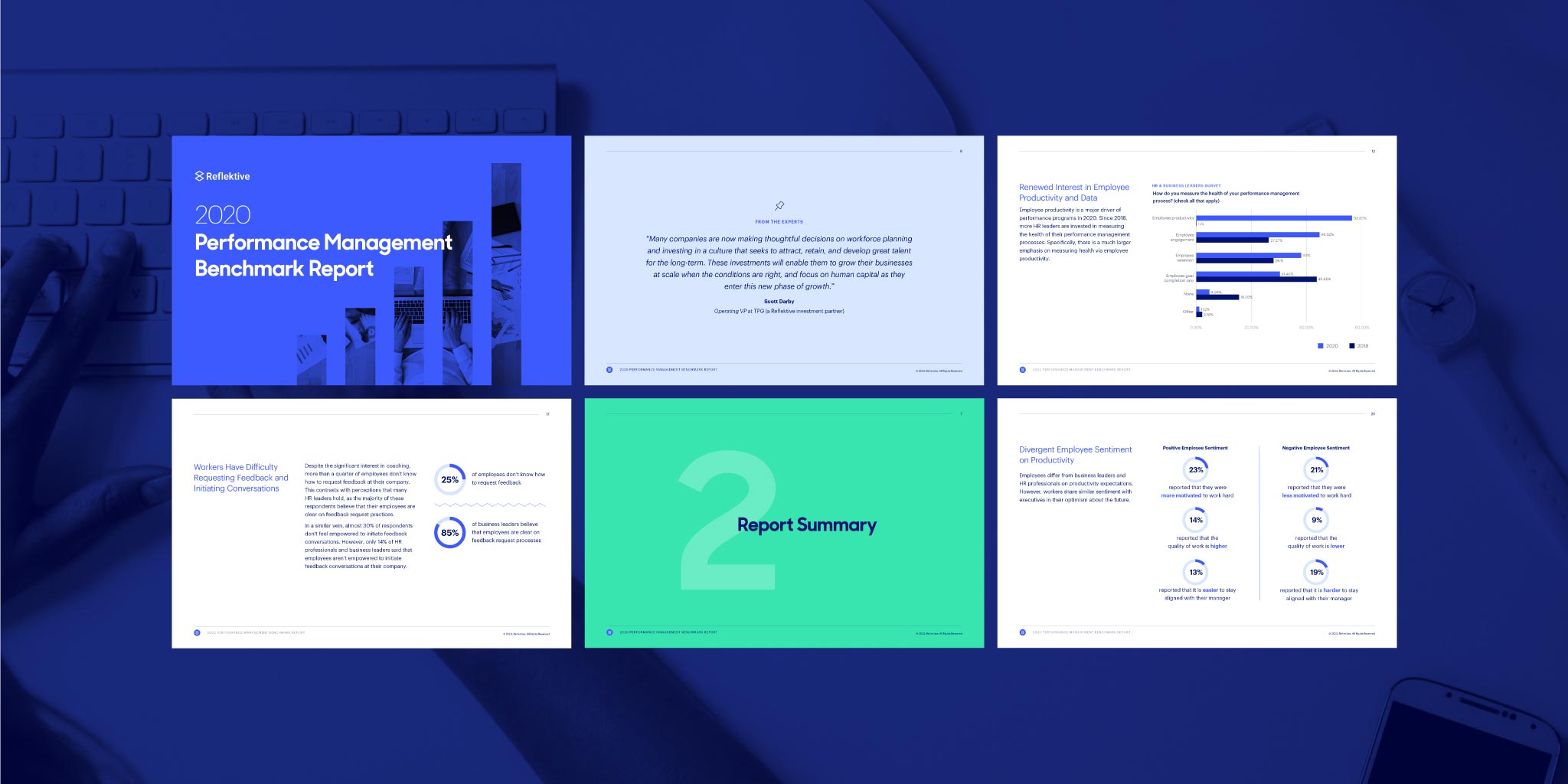
Results from Reflektive’s 2020 Performance Management Benchmark Report also indicate that employees aren’t receiving enough information from their company:

These data points contrast sharply with employee needs, which include more visibility. In the same benchmark report, Reflektive uncovered that employees want more support via:

So how can organizations provide consistent communication, including recognition and feedback? Our recommendations below include actionable steps that HR teams, leaders, managers, and employees can take to make their company a better place to work.

HR Best Practices

There are several policies and programs that HR teams can launch to drive organizational transparency. We recommend that companies of all sizes start with the following best practices:

Executive Best Practices

Leaders play a key role in shaping an organization’s culture of transparency. We encourage executives and HR teams to partner together to bring these practices to life:

Manager Best Practices

Managers are a key partner in scaling organizational transparency. They can communicate company-wide updates in a personalized way, and they shed more light on promotion and pay raise decisions. Some key best practices for managers are available below:

Employee Best Practices

All employees can contribute to an open, accessible workplace culture! With feedback and regular communications, they can improve work life for themselves and their peers:

If your organization is looking to boost transparency, accountability, and alignment, schedule a consult with a Reflektive expert.

Measuring Employee Experience

Creating a strong employee experience is a top priority for HR leaders in 2021. Per Gartner, 28% of HR leaders, 31% of CHROs, and 46% of Diversity & Inclusion leaders believe that the employee experience is crucial to get right. While there are myriad recommendations on how to build an ideal employee experience, many companies consult with Reflektive on how to measure sentiment. What metrics are most important to track? How can HR teams view their progress? Check out our recommendations below on making the employee experience quantifiable. But first…

What is the Employee Experience?

Per Gallup, the employee experience is “the journey an employee takes with your organization. It includes every interaction that happens along the employee life cycle, plus the experiences that involve an employee’s role, workspace, manager and wellbeing.” 

The breadth of the employee experience means that it can’t easily be captured in one metric. HR teams should look to domain-specific data to better understand their current strengths and areas for improvement. The components of employee experience are:

How should HR teams evaluate the Employee Experience?

For quantitative insights on the employee experience, we recommend that HR teams evaluate four data types: employee survey responses, leading indicators, lagging indicators, and business KPIs. Together, these metrics create a holistic picture of the employee experience, and help you better identify areas for improvement. A refresher on the differences between leading indicators, lagging indicators, and business KPIs, is below:

To measure the employee experience, employee survey responses as well as some leading and lagging indicators can be sourced from engagement surveys. Other indicators and business KPIs are available from your finance team, people analytics solution, and software tools used by your business.

HR teams can also conduct employee interviews for qualitative insights. This article will focus on quantitative data that can easily be gathered by companies of all sizes.

Recruiting Data

To ensure that your recruiting process is equitable and inclusive, ask candidates questions around respect and professionalism of the team. You can further slice survey data by candidate demographic (such as age, ethnicity, gender identification) to see if there are any biases in your recruiting program.

Recommended metrics include conversion and retention, which indicate fairness, transparency, and efficacy of your recruiting program.

Survey Questions“The recruiting team kept me informed at all stages of the process.”
“The people I interviewed with treated me respectfully.”
“I received helpful answers to my questions during the interview process.”
“Overall, I had a positive experience interviewing with this company.”
“I would refer a friend to a role at this company.”
Leading IndicatorsAverage number of candidates
Career site traffic
Lagging IndicatorsAverage cost of hiring
Average time to hire
Recruiting conversion rate
Business KPIsFirst year retention rate

Onboarding Data

After the recruitment experience, the next major influencer of employee sentiment is onboarding. Not only does a structured onboarding process increase new hire productivity by 50%, but it’s also associated with a 58% higher three-year retention rate.

To assess the onboarding experience, ask new hires questions on the helpfulness of onboarding content, and their understanding of their new role. Helpful indicators include employee productivity and engagement.

Survey Questions“The job description accurately depicted the role I’m in today.”
“I received helpful company information during onboarding.”
“I understand my company’s goals.”
“I understand how my work will be evaluated.”
“I have a clear understanding of my responsibilities and what I am expected to accomplish.”
“I feel welcome and part of the team.”
Leading IndicatorsOnboarding completion rate
Lagging IndicatorsTime to productivity
Overall engagement score among new hires
Business KPIsFirst year retention rate

Performance Management Data

Similarly, performance programs have a meaningful impact on the employee experience — and countless other business metrics. Some insights include:

To assess employee sentiment on performance management, include questions about their role, and how their work is evaluated and compensated. Since performance is integral to organizational success, we recommend assessing metrics such as profit margin and market share as key outcomes.

Survey Questions“I like our processes for reviews, feedback, and goal-setting.”
“I know how to do well in my job.”
“I am paid fairly for my job.”
“I understand how my work is evaluated.”
Leading IndicatorsGoal completion rate
Review completion rate
Percentage of employees that request feedback
Percentage of employees that have given or received recognition
Lagging IndicatorsEngagement score
Operational performance (e.g., cost per click for Marketing team, conversion rate for Sales team)
Innovation (e.g., gaining third party validation or launching a new solution)
Business KPIsProfit margin
Revenue
Market share
Retention rate

Manager Relationship Data

Another key driver of employee happiness is the individual’s relationship with their manager. Per Gallup, managers account for up to 70% of variance in employee engagement. 

HR teams can assess manager impact – good or bad – by asking survey questions on manager support and leadership. Helpful indicators include engagement and promotion data for each manager.

Survey Questions“My manager helps me solve problems.”
“I have the right level of autonomy to do my job well.”
“My manager cares about me as a person.”
“My manager helps me to develop key skills.”
“My manager sets a high standard of excellence for the team.”
“My team and I feel inspired by our manager.”
Leading IndicatorsGoal completion rate by manager
1:1s scheduled by manager
Lagging IndicatorsEngagement score by manager
Number of promotions by manager
Business KPIsRetention rate by manager

Talent Development Data

While managers play a role in employee growth & development, company-wide processes also affect advancement. Are there distinct career paths for employees? How can workers pursue learning opportunities? 

To assess the experience around talent development, ask survey questions on employee enablement and current role satisfaction. For other helpful data points, look to internal mobility and performance ratings.

Survey Questions“I have the option to move to other roles within my company.”
“I understand how to grow my career at my company.”
“I use my best strengths in my job every day.”
“You’ll probably see me working at my company two years from now.”
Leading IndicatorsPercentage of employees with weekly manager 1:1s
Percentage of employees that had career conversations
Lagging IndicatorsPercentage of new roles that are filled by current employees
Percentage of employees that “meet expectation” and “exceed expectation” in performance appraisals
Business KPIsRetention rate among top performers

Communication & Collaboration Data

The ability to partner well with peers also makes a difference in employee experience. While it’s difficult for companies to make an instant impact on teamwork, they can encourage collaboration and build a culture of trust and transparency. 

HR teams can ask employees questions on peer interactions, and the input they receive from colleagues. Data points around innovation and operational performance help HR professionals assess collaboration.

Survey Questions“Other teams partner well with my team to get work done.”
“I get meaningful recognition when I perform well.”
“The feedback I receive helps me improve.”
“My voice is valued.”
Leading IndicatorsPercentage of employees with weekly peer 1:1 meetings
Percentage of employees that request feedback from peers
Lagging IndicatorsInnovation (e.g., gaining third party validation or launching a new solution)
Operational performance (e.g., cost per click for Marketing team, conversion rate for Sales team)
Business KPIsCompany-wide goal completion rates
Profit margin
Revenue
Market share

Well-Being Data

Peer relationships and interactions also shape employee well-being, a topic that has become even more important to HR teams. As employee stress has increased this past year, companies are responding by offering more mindfulness programs (11% increase) and on-site stress management programs (13% increase). 

Additionally, well-being includes feelings of belonging and inclusion at work. Per Reflektive’s HR Trends Report, companies are responding to this employee need and over 90% of organizations are now making DEI a priority.

In your survey to employees, include questions about work-life balance and an appreciation of differing viewpoints. Common HR metrics – including engagement and retention – also indicate whether employees feel happy and healthy at work.

Survey Questions“I’m able to have work-life balance.”
“I have healthy, positive relationships with coworkers.”
“I feel a sense of belonging at work.”
“I can balance my needs with the needs of others.”
“Perspectives like mine are included in decision-making.” 
“My manager encourages people with different ideas and opinions to speak up.”
Leading IndicatorsNumber of company-wide programs to foster employee well-being
Participation rate in well-being programs
Participation rate in DEI programs and activities
Lagging IndicatorseNPS
Engagement score
Business KPIsRetention rate

Workspace Data

Another element of employee experience that has been recently brought into the spotlight is workspace setup. Based on Reflektive’s Employee Sentiment Report, one of the most prevalent comments from employees is that their home office setup isn’t sufficient. With millions of employees now working from home, this challenge can meaningfully impact overall productivity and happiness at work.

We recommended including workspace questions in company-wide engagement surveys. Sentiment around productivity in the home office can shed a light on the employee experience. Data on IT and equipment requests reveal trends in employee workspace needs.

Survey Questions“My work environment enables me to be productive.”
“I have all the tools and resources I need to perform my job effectively.”
“I’m able to disconnect from work when the workday is over.”
Leading IndicatorsTrends in IT requests
Trends in equipment requests
Lagging IndicatorsOperational performance (e.g., cost per click for Marketing team, conversion rate for Sales team)
Business KPIsCompany-wide goal completion rates
Profit margin
Revenue
Market share

There are many facets of the employee experience that are important to track and measure. We recommend assessing these domains in your engagement survey, or following up on specific topics in pulse surveys. Additionally, having a comprehensive HR dashboard will allow you to view employee experience data in real-time.


Looking for more ways to improve the employee experience? Schedule a quick consult with an expert.

Performance Reviews in 2021

Performance reviews have a meaningful impact on employee motivation. In fact, people who like their company’s review processes are 2.9X more likely to work harder than they have at past organizations. So how can companies make performance reviews better in 2021? Read below for helpful information on how reviews can do more for you.

What is a performance review?

A performance review is a formal evaluation of employee performance. Reviews can be completed by managers, teammates, and cross-functional colleagues. The HR team provides reviewers with forms to assess the employee’s performance. Reviewers may be asked questions such as:

The employee may complete a self-assessment as well, in which they identify key contributions and areas of opportunity. Once the reviewer and reviewee have completed their assessments, they meet to discuss the employee’s performance, and align on goals and skills that would benefit the individual and the company.

Why do performance reviews matter?

Reviews are a crucial element of a holistic performance program. Review conversations are an ideal forum to:

What’s more, having an employee-centric review process shows that your company is committed to growth and development, and can result in higher employee satisfaction and retention. Those who like their review processes are:

How can I make reviews better for employees?

There are myriad ways in which companies can improve the review process! We’ve bucketed them into the three categories below:

Enable Employees for a Successful Cycle

Manage employee expectations from the get-go. Include context on the upcoming review cycle by addressing the following questions in emails, intranet pages, or other employee-facing content:

Adopt a Development-Focused Approach

Reviews are often perceived by employees as stress-inducing. And only 14% of workers strongly agree that their performance reviews inspire them to improve. Many companies are responding to this by creating review cycles focused on positive reinforcement and continuous improvement, rather than a “what went wrong” approach. This development-focused approach can be incorporated into review forms, where HR teams can add questions such as:

Gather Insights to Continuously Improve

After your review cycle, take a pulse on employee sentiment to learn what was most helpful, and what can be improved. Whether you gather feedback via a survey or poll, or through focus groups and interviews, ensure that you ask what went well, what questions were valuable, and what would make performance reviews even more productive. 

How often should companies have performance reviews?

We believe that formal performance conversations should be conducted on a quarterly basis. These can take the form of a manager review, 360 review, and/or a check-in. More details on the differences between these review types is available in Reflektive’s HR Guide to Designing a Reviews & Check-In Program.

What questions should be included in employee self-assessments?

We recommend the below questions based on the objective of your review cycle. In general, it’s best to keep your form short and limit it to 4-7 questions.

Building a culture of feedback

Improving alignment

Developing careers

Improving performance

Informing talent management decisions

How should companies launch review cycles?

Launching a review cycle requires the coordination of many different moving parts. The following launch plan can help companies create a streamlined process, and drive higher completion rates too.

Step 1. Get executive buy-in

Ensure the entire leadership team is aligned on your review objective and strategy.

Step 2. Share your plan with managers

Schedule a manager training session to share the review cycle timeline and process prior to communicating with the broader organization. Ensure that managers are equipped to answer their team’s questions.

If you’re unable to hold a manager training session, provide managers with information on a wiki or intranet site. We recommend holding office hours so managers can stop by with questions or get assistance on preparing for their conversations.

Step 3. Send a company-wide communication

In your launch email, include information on the “why”, “what”, and “when” of your review cycle. Encourage everyone to block time in their calendars for completing reviews so they can finish them before the deadline (HR teams can also send calendar holds for all employees!) Finally, we recommend office hours for individual contributors so they can ask questions on the upcoming cycle.

Step 4. Launch your review, and use nudges if needed

Nudges remind employees to complete their reviews. In fact, most Reflektive customers use three nudges per cycle. Additionally, you can get higher completion rates by partnering with managers. For example, managers can share with their team that they’ve completed their review, and lead by example. 

Step 5. Track progress!

Leverage a people analytics platform to keep track of completion rates and other KPIs.

Step 6. Ensure fairness by calibrating

Gather team leaders for calibration sessions. Adjust performance ratings to account for leaders who may be easy or hard graders.

How can HR teams best prepare for performance reviews?

HR teams can benefit from completing the below tasks prior to launching a review cycle:

Develop success criteria for the review cycle

We recommend setting a desired completion rate, and establishing baseline employee sentiment metrics that are assessed post-review. For the completion rates, see what percentage of employees completed their reviews on-time. For 360 reviews, assess peer completion rates too. Employee sentiment, on the other hand, can be measured with a poll or engagement survey post-review cycle.

Incorporate employee feedback, recognition, and goals into the review form

Build a holistic picture on employee performance by pulling in helpful data. These insights help foster a discussion on key accomplishments, and what can be improved moving forward. Tip: encourage employees to always ask for feedback after a project is completed to get timely learnings!

Ensure goals and action items are up-to-date

As business needs evolve at your company, make sure that employees and managers are updating their goals and key projects. To ensure that direct reports are staying in-sync with organizational objectives, encourage weekly 1:1s and a strong company-wide communication plan.

How can managers best prepare for performance reviews?

To help managers prepare for an upcoming cycle, we recommend the following best practices:

Keep Consistent Notes

Detailed notes are your best friend when it comes to review prep. Save, categorize, and view feedback from throughout the year, track employees’ goal progress, and review discussion topics from 1:1 conversations.  

Review Goal Progress & Establish Upcoming Goals

Evaluate your employees’ goals from previous reviews. Did they accomplish their objectives? If not, what could they have done differently? Based on their past performance, choose a handful of goals to discuss during the review. These can provide a solid framework to help the employee identify areas for improvement and establish goals for the upcoming 3, 6, or 12 months.

Provide Regular Feedback

When you regularly provide feedback to employees, preparing for a performance review doesn’t feel like a Herculean task anymore. The employee has a better idea of where they stand, and you have prior conversations to draw from when preparing for reviews. 

How can employees best prepare for performance reviews?

Employees can put their best foot forward for the upcoming review cycle by doing the following:

Ask for Feedback

Nearly 85% of Millennials surveyed said they would feel more confident if they could have more frequent performance conversations with managers. The easiest way to get that conversation started is simply to ask your manager for feedback—regularly, throughout the year, and not just during reviews. It demonstrates initiative and a commitment to growth. And the more frequently these check-in conversations occur, the less uncertain (and anxious) you’ll feel when it comes time for your review.

Be Prepared

Know the format of the review. If you want to discuss a promotion or raise, have a target in mind with compelling talking points to support your case. Make a list of accomplishments and positive feedback that you’ve received. Also, take time to self-reflect and identify weaknesses, so you won’t be blindsided by negative feedback. Preparation is the best way to eliminate nervousness.

What should people do after performance reviews?

The below best practices help companies drive improved employee productivity, performance, and development after their review cycles.

  1. Canonize review program requirements and best practices
    If you haven’t already, make sure your review requirements – including self-assessment, meeting with your manager, etc – are documented and always available to employees. Include a reviews “Best Practices” section in your documentation as well — check out this article for ideas!
  1. Send an engagement survey or poll
    There are so many learnings that HR teams can generate from the performance review experience! We recommend sending out a survey or poll that covers the performance appraisal process and follow-up. Include questions such as, “Was information in the performance conversation valuable to you?” and “Do you feel that your performance has changed?” Insights from the survey will help you make continuous improvements that ultimately boost productivity.
  1. Hold a review post-mortem
    Conduct focus groups – and use pulse survey insights – to learn what went well in this review cycle, and what can be improved. Once your data is gathered, schedule a post-mortem with your HR team to shape plans for future cycles. 
  1. Document and share changes for future review cycles
    Once your HR team is aligned on the changes to be made for future cycles, document them and share them with employees. Let employees know when the next review cycle will be, the modifications you’re making, and why. This information can live on a wiki or intranet page, and should also be proactively shared with employees via email and all-staff meetings.
  1. Reward high performance
    Are employees knocking out high-priority deliverables left and right? Reward them! Whether employees are incentivized by food delivery or donations to their favorite charities, we also recommend sharing public recognition to build a culture of praise.
  1. Have managers follow-up on areas of improvement
    Conversely, if an employee is struggling with their objectives or developmental plans, encourage managers to speak openly with them and engage in problem-solving together. Bosses can also drive the importance of accountability for achieving team success.
  1. Encourage employees to get feedback after every project
    To drive continuous development, encourage employees to request feedback after major projects and milestones. By learning from teammates about what went well and where they can improve, employees will receive relevant (and timely!) insights that will help with future projects.

What other tactics can help employees improve performance?

Performance reviews aren’t the only way to help employees do better in their jobs. We recommend the below programs to complement reviews and equip workers for success.

Encourage more frequent 1:1 conversations

Weekly or bi-weekly 1:1s with managers help employees work towards the right objectives. While we generally recommend that 1:1s are employee-driven, manager-driven 1:1s are also appropriate for driving alignment and following up on important business updates.

Boost company-wide recognition

To drive awareness of wins across the organization, we recommend more frequent employee recognition. HR teams can create a contest or a challenge to encourage kudos from workers.

Encourage employee-driven feedback

Between review cycles, employees can proactively request feedback from managers, peers, and cross-functional colleagues. This will help them grow professionally and develop core skills. Additionally, if your HR team is overburdened and cannot run reviews now, employee-driven feedback can replace reviews.

Modify goals as needed

Finally, to ensure that employees are set up for success in an ever-changing environment, enable workers to adjust goals as needed. Additionally, if it’s too difficult for certain employees to work towards numeric results, managers can create qualitative scorecards to reward employee behaviors. 

To build a successful performance review program, HR teams should think through their high-level objective, and the strategy and tactics that will help them achieve that goal. Building an employee-centric review process – focused on growth & development – will make review conversations even more valuable to workers. To craft the right program for your organization, schedule a consult with an expert.

Reflektive Awarded Multiple Leader Designations from G2, Silver Excellence in Technology from Brandon Hall Group

We’re excited to announce that Reflektive received seven Leader awards from G2, and the Silver award for Best Advance in Performance Management Technology from Brandon Hall Group

Brandon Hall Group has been in existence for 27 years, and it offers data, research, insights and certification to executives and organizations. The Excellence in Technology Award was given based on program design & delivery, measurable benefits, and overall impact.

G2 is the world’s largest tech review marketplace, with over 1 million reviews from users. The seven G2 Leader awards that Reflektive won span performance management and employee engagement, and include:

Per Barbara Competello, Chief Customer Officer at Reflektive, “We are very happy to be recognized for one of Reflektive’s core values: relentless customer commitment. Reflektive was built to drive outcomes that matter – including improvements in retention, engagement, and productivity – and receiving this validation from third parties and from our customers is always exciting to hear.”


If you’re interested in learning more about what Reflektive customers are saying, check out our G2 reviews.

How to Show You’re Thankful for Your Employees

The holidays are the perfect time to show your employees how much you value and appreciate them. To get into the spirit, here are some top ways to say “Thank You” to your team members.

A Simple “Please” and “Thank You”

In a fast-paced workplace, manners can sometimes fall by the wayside. So, this is the perfect time to remember what your parents taught you—a simple “please” and “thank you” can make a huge difference when communicating with your coworkers.

Publicly Recognize Their Work

Praise your employee’s efforts at an all-hands meeting, departmental meeting, or on a public recognition wall. Share specific helpful behaviors, and give kudos on projects they rocked. Doing this publicly will also encourage others to share positive feedback, and it’s a great note to end the year on.

Give Them A Little Extra Time-Off

Take the stress out of the holiday season by being flexible on scheduling. Allow employees to leave a couple hours early, or give them a half day off on the Friday before a holiday weekend. Show them that you value their work-life balance and time spent with family and friends.

Personalized Gifts or Handwritten Cards

Give employees an end-of-year gift with a handwritten thank-you card acknowledging all their work throughout the year. Again, point out specific actions and behaviors that you feel are their strengths. Let them know why they’re so valuable to the team.

Feed Them

Hey, who doesn’t love food? You can bring in catered lunches for office-based staff, or ship treats to folks working from home. Food delivery gift cards are a favorite among Reflektors!

Provide Growth Opportunities

The greatest gift you can give employees is demonstrating that you’re invested in their long-term development. So, give them the chance to lead a meeting, attend a virtual conference, deliver a company-wide presentation, or represent the team on interdepartmental committees. It’ll set an exciting tone for their growth in the year ahead.

Adopting Continuous Conversations at Newport Group

Newport Group helps companies offer their employees a more secure financial future through retirement plans, insurance, and consulting services. With 1,500+ employees and 26 offices, Newport needed a performance management strategy that aligned with how the company conducted business and offered employees frequent career and growth conversations. Below is our Q&A with Jackie Ward, CHRO at Newport Group, about how they transitioned from an annual look-back on performance and to more continuous conversations. 

Reflektive: Can you tell us about your team at Newport and how you support the company’s performance management programs?

Jackie: Our HR team has thirteen employees, and we cover core HR functions, learning and development, talent acquisition, and engagement (diversity and community work). I spearheaded the Reflektive decision-making process back in 2017 and oversee the partnership, with my team members driving the day-to-day operations. 

Reflektive: What was performance management like prior to using Reflektive?

Jackie: Reviews happened once a year, and was a look-back on past performance. Compensation was often too closely connected with reviews, and became the focal point of the conversation. I also wanted to explore disconnecting pay from the conversation to give employees and managers an opportunity to speak to career and growth. The experience was very rigid and not beneficial for our employees. 

Reflektive: Why did you decide to make a change to your performance management program?

Jackie: When I first joined, the company was undergoing a period of substantial growth. Newport is agile and fast-moving, and I wanted our performance management strategy to align with our culture. We also had a number of exciting acquisitions, so we wanted to ensure that employees had the opportunity to develop relationships and have ongoing conversations across the company. Our CEO is a strong believer in continuous conversations, connections and building relationships.  

Reflektive: When reviewing, why did you decide to go with Reflektive?

Jackie: We reviewed a number of different platforms, and it came down to:

Reflektive: How is your company using Reflektive?

Jackie: Reflektive offers our employees the structure for more continuous conversations. Employees are encouraged to have casual 1:1s at least monthly, a more formalized quarterly check-in and annual skip level conversations. The process is well received and we average a 97% completion for our quarterly check-ins. 

Our culture has always been keen on promoting kudos and shoutouts. With Reflektive, I really like how Recognition is pulled into check-ins, so managers can avoid any recency bias and pull in all the great work their teams are doing. 

We’re also regular users of Goals. We set goals on a quarterly basis, and the product allows employees the flexibility to adjust and update should anything change. 

Reflektive: How do you educate employees and drive adoption of Reflektive?

Jackie: Reflektive is integrated into a number of our onboarding and training programs. During employee onboarding, we have a dedicated training for all new employees. We also host a number of 2-3 minute videos on our Intranet that offers a refresher of different aspects of the product that employees regularly use. 

Following each quarterly check-in, we share completion rates in our All-Employee meetings. My HRBPs attend management meetings, and take each business leader through their team’s results and future improvements for conversations. 

Reflektive: With COVID-19, what changes have you implemented?

Jackie: Pre-COVID, our workforce was across 26 offices and we still needed to connect with one another. A silver lining of COVID is it made our workforce much more comfortable engaging in meaningful conversations over video. 

In April, we ran the Coronavirus Sentiment Survey and earned a 91% favorability among our employees. The survey offered us timely data points on what’s going well, what employees needed to be successful, and deeper insight into their challenges. The key themes that emerged were: 

We’ve fed the responses back to the employees, followed up with several individuals, took action to provide more information on childcare and shared the data with business leaders so they can continue to follow up with managers who may not be doing such a good job of staying connected to their people.  

Reflektive: As we look ahead to 2021, what are your priorities?

Jackie: My priority will be around what the future of our workforce will look like. We learned from engagement surveys that employees crave connectedness and relationship-building. Our company will likely stay remote for most of 2021, but we’re starting to have a lot of conversations around the reality of what it’s going to look like as employees are able to return to the office.

Recognition in the Tech Industry – Best Practices from Reflektive Customers

All of us love the feeling of being appreciated. It lifts our spirits, and makes us feel like valued members of our team. And recognition goes even further than that — people who receive meaningful recognition are 3.6X more likely to work harder than they have at past companies and 3X more likely to recommend their company as a great place to work.

So how can tech companies motivate their very busy employees to take a few moments and provide kudos? Below are best practices from Reflektive customers Enquero, Alfresco, and Brad’s Deals on how they’ve built a culture of appreciation across their tech-savvy workforces. 

Best Practice 1: Set Recognition Goals

Start by setting a company-wide recognition goal. Having a north star – and one that’s measurable! – will help better guide team and individual efforts to provide more praise.

So how can tech firms best set recognition goals? Enquero’s goal was to “create a culture of thanks”, and they measured their success by analyzing the percentage of employees that received recognition (77% shortly after their launch!) 

Other ideas for quantifiable recognition goals include:

Best Practice 2: Incorporate Recognition Into Existing Programs

Tech companies can boost their culture of appreciation by including recognition in 1:1s, check-ins, and other programs. Alfresco encourages employees to ask questions such as, “What am I doing well?” and “What do you like about my work?” in their 1:1s with managers.

Brad’s Deals enhanced their check-ins with “shout-outs” from Reflektive. Within the check-in form, managers can see all of the recognition (or “shout-outs”) that the employee has received. This added information provides a holistic picture on employee performance, and helps eliminate recency bias. “Shout-outs have been instrumental for us as we’re looking to enable the most robust performance conversations,” said Jessica Adams, Brad’s Deals’ VP of People.

Busy tech employees are also more likely to provide recognition when it’s built into their existing workflows. In fact, employees who use our email and chat integrations generate 3X more feedback. Enquero employees provide recognition with Reflektive’s Microsoft Teams integration, while Brad’s Deals team members use Reflektive’s Slack integration.

Best Practice 3: Use Other Channels to Bring Recognition to Life

Finally, Reflektive’s technology sector customers have gotten creative with additional ways to make recognition front and center. Alfresco uses a variety of tactics to make kudos more visible and drive their culture of appreciation:

Additional ideas to encourage appreciation?

Looking for more insights to help your tech company launch a recognition program? Chat with an expert.

Driving A Culture of Continuous Feedback at Old Second National Bank

Old Second National Bank has served the Chicago area for almost 150 years by providing communities with a full array of consumer and business products and services. The company has injected the same principles of dedication and continuous support in their employee programs too. In 2017, Old Second partnered with Reflektive to provide employees with tools that support continuous feedback, and ultimately drive more equity and inclusion. Read our below Q&A with Heather Anderson, Human Resource Business Partner, to learn how Old Second boosted its corporate culture with Reflektive.

Reflektive: Can you tell us a little bit about Old Second?

Heather: For nearly 150 years, Old Second has been a pillar in communities, meeting the banking needs of Chicago-area businesses and individuals. Our employees and customers are at the core of our success. Backed by an unwavering sense of financial responsibility, we’ve persevered through the most challenging and rewarding economic climates, as well as more than two centuries of historical events. 

Reflektive: Why did the company decide to partner with Reflektive in 2017?

Heather: We wanted to drive talent management forward at the company, and we knew that leading-edge performance programs could help us do that. The ability for employees to gather continuous feedback from colleagues, and develop skillsets, was extremely important to us as we searched for the right platform. Another key goal for us was to evolve our performance management process to create an even playing field for all of our associates.

Reflektive: That’s so good to hear. Can you talk a little bit more about how you accomplished these goals with Reflektive?

Heather:  We actually were able to tackle a lot of these initiatives with our new performance review process:

Reflektive: Are employees taking advantage of goal-setting opportunities?

Heather: Definitely! We’ve seen goal adoption increase from 30% in 3Q2019, to 84% in 4Q2019, and it’s currently at 94%. That’s an increase of over 200% since the third quarter last year!

Reflektive: How did you make such a large improvement in goals adoption?

Heather: I used a multi-pronged approach here, including:

Reflektive: That’s a very comprehensive strategy! Are there any additional tactics you’re using to drive a culture of continuous feedback at Old Second?

Heather: Yes, we use several channels to help employees grow and develop. Specifically, we:

Reflektive: You mentioned that 1:1s and reviews help drive positive sentiment around inclusivity — are there any other programs you’re developing to create a more inclusive workplace?

Heather: Yes, we’re doing a lot to support all of our associates. We established an executive DEI council that also includes employee ambassadors to incorporate different voices. The council identified five DEI initiatives that will commence in 2021: